
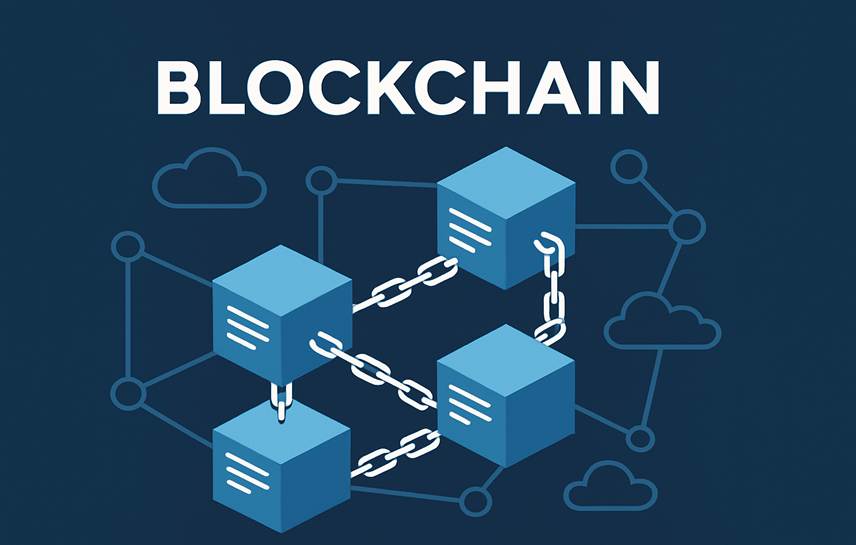
The blockchain is a computer technology that appeared in 2008 with the launch of Bitcoin, but it’s very principle applies beyond cryptocurrencies.
The main goal of the blockchain is to record information in a chronological, secure way, and most importantly in a decentralized manner. We can compare it to a big book, where each new operation is recorded permanently, without the possibility of deleting or modifying them. These operations are visible by all participants of the network and each one has the possibility to verify the authenticity, which will therefore guarantee transparency. Unlike traditional databases which are controlled by a central entity, such as in a bank or in a company, the blockchain works without a unique authority. It relies on a network of interconnected computers which work together in order to record and validate the different information.
This technology has the particularity of being able to create an environment of trust without a trusted third party. The blockchain therefore allows people or organizations to collaborate, exchange, or make transactions in a secure way, even if they do not necessarily know each other. This technology opens the way to new economic and social models. It is for this reason that the blockchain is very often described as being a very important innovation in our current world, because this technology could deeply change our ways of storing and exchanging data in all sectors of society.
How does it work?
To better understand how a blockchain works, imagine a system where each piece of data is kept in a series of digital blocks. Each block corresponds to a group of operations recorded at a given time. All these blocks are linked together thanks to a unique cryptographic signature (which are called “hash”), which depends on the content of the block. So, if the content changes, even slightly, the hash will completely change, which therefore makes any attempt of falsification immediately detectable. This aims to make any hidden manipulation impossible, because a simple manipulation would break the whole chain.
The validation process is just as important. When a user wants to add a new transaction to the register, it is first broadcasted to the whole network. Then the different computers of the network (called nodes) check that this transaction is indeed in accordance with the different rules that are established. This verification is therefore carried out collectively, which aims to prevent a single person or organization from taking control of the system. Finally, once this transaction is validated, it is included in the block, and that block is added to the chain.
What is the blockchain used for?
The blockchain is not limited only to cryptocurrencies. It has a much wider potential for application than we think; it affects fields as varied as industry, public services, health, and many others. One of the most concrete examples is that of smart contracts. They allow certain transactions to be automated without human intervention. A smart contract is a computer program that runs automatically when predefined conditions are met. For example, during a real estate purchase, the contract can automatically transfer the funds at the delivery of the property, without needing the intervention of a notary or a lawyer. This allows, on one hand, to save time but also to reduce fees and therefore avoid errors or abuse.
Advantages of Blockchain:
- Enhanced security
- Data is encrypted, unchangeable, and permanently recorded, making fraud and tampering nearly impossible.
- Full transparency
- All transactions are visible to all participants on the network, which increases trust.
- Decentralization
- No central authority controls the system, reducing the risk of corruption or censorship.
- High reliability
- The network continues to function even if some computers go offline, since every node has a full copy of the blockchain.
- Fewer intermediaries
- Transactions happen directly between users, reducing costs and delays.
- 24/7 operation
- The network runs nonstop, all day, every day, anywhere in the world.